And one day, lunch and recess became just lunch.
As children, recess was a space where we could freely choose activities with friends, a break we eagerly anticipated within the structured rhythm of the school day. Our choices weren’t endless; we drew from a familiar circle of peers, shaping our play around close-at-hand suggestions and possibilities.
Now, immersed in the digital world, insights and options stretch out like an entire universe—every planet seemingly within reach, yet we hold no telescope to see them. With so many distant choices, it’s easy to overlook what’s visible through the simple perspective of our own eyes.
In our downtime, we scroll through algorithm-driven feeds and curated recommendations—tips on which rise of jeans to buy, advice on choosing the “best” exercise for a particular look, or the latest productivity app promising to transform our daily routines.
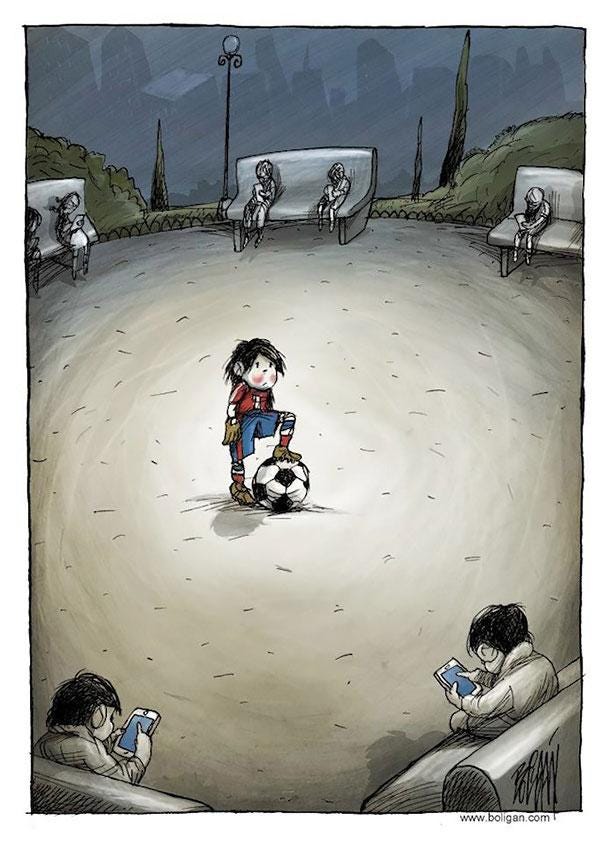
Illustration by Angel Boligán (www.boligan.com), capturing today’s playground reality, where our free time is drawn to the countless options offered in the digital world.
In this digital world overflowing with content, it’s worth asking: Is what we’re consuming fueling our internal congruence, or pulling us deeper into cycles of compulsion?
It’s easy to get caught in the game of what I define as “Tug of War through the 10 C’s of Consumption”—a model for identifying when what we’re consuming pulls us between what aligns with our authentic selves (congruence) and what draws us away (compulsion).
Tug of War through the 10 C’s of Consumption
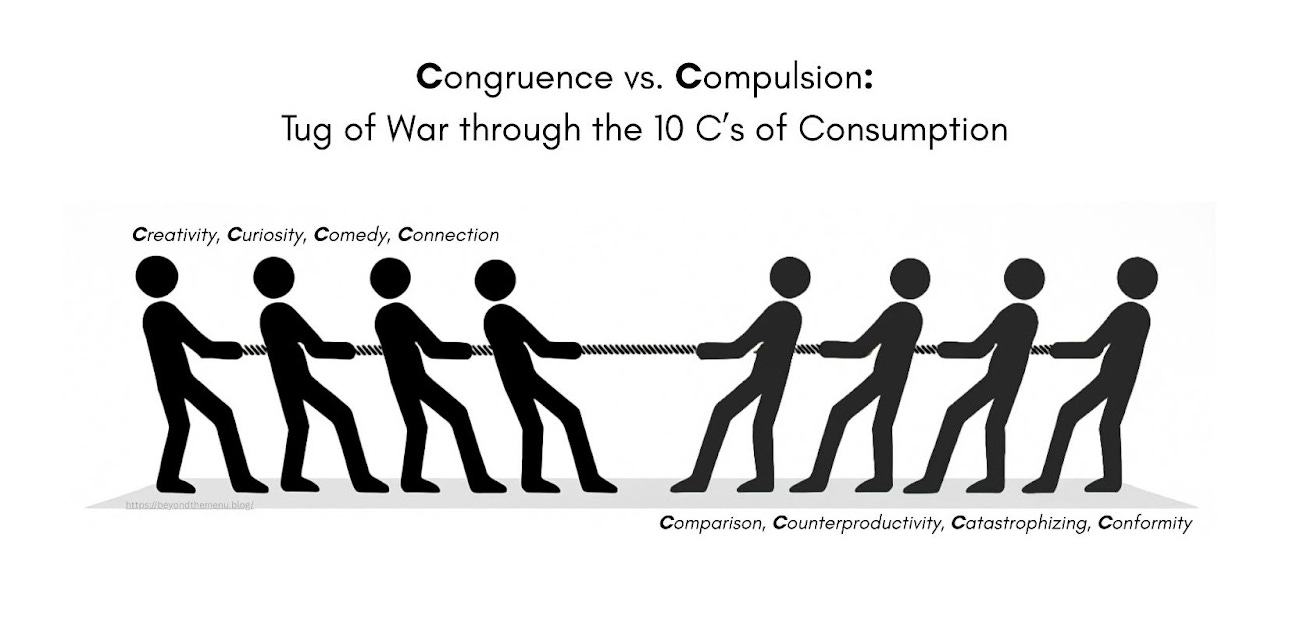
Congruence Team: Creativity, Curiosity, Comedy, Connection
Congruence, as defined by the pioneering humanistic psychologist Carl Rogers, is the alignment between a person’s self-concept and their lived experience. This process unfolds through ongoing self-awareness and honest communication. Congruence matters because it anchors psychological well-being and authentic growth; when we consistently engage with media and habits that draw us away from our core values, we experience what Rogers called incongruence—a disconnect between our true selves and the lives we lead (Rogers, 1959).
Creativity: Content that encourages insight, sparks imagination, and inspires us to make something new—whether that’s writing, painting, scrapbooking, photography, designing dance routines, composing music, or countless other creative forms. Observing which kinds of content capture our interest can inspire us to notice what truly sparks our sense of creativity and motivates us to explore new ideas or hobbies.
Curiosity: Content that sparks personal interests and invites joyful exploration—through books, podcasts, or other media. Curiosity inspires us to build our own curriculum, and this learning doesn’t have to be purely academic. The best learning often isn’t about worksheets; it’s whatever keeps us interested, asking questions, and wanting more—maybe a podcast that teaches something unexpected, a YouTube how-to, or a story that sends us down a research rabbit hole. One benefit of our digital world is having access to countless how-tos, whether that’s makeup tutorials, new recipes, or any hobby that sparks curiosity. The point is to utilize formats that educate, foster skill-building, and deepen meaningful interests.
Comedy: Content that brings humor and reliable laughter—offering relief from stress and providing both physical and emotional release. Anything that consistently makes us laugh—funny shows, TikToks, memes, stand-up specials—helps uplift our mood and foster social connection. Revisiting old videos or a comfort show can create a sense of comedic safety (mine being New Girl, a comfort show that never fails to make me laugh). These moments break up heaviness and keep things light, especially when life feels overwhelming. There are even guided meditations now explicitly designed to spark laughter as a form of release, like those on the Insight Timer app.
Connection: Content that resonates with our lived experience and helps us relate to others—whether through a character’s journey in a show, a story that echoes familiar themes, or a podcast that makes our inner world feel heard. Connection can also be deeply nostalgic: listening to music from years past, revisiting favorite old playlists, or scrolling through songs that shaped our younger selves, providing an opportunity to reconnect with our past selves and reflect on where we’ve grown.
Compulsion Team: Comparison, Counterproductivity, Catastrophizing, Conformity
Compulsion, the experience of “feeling like a fraud,” fueled by constant input from social media and digital platforms, manifests as automatic, repetitive behaviors that work against our conscious intentions and well-being goals.
Comparison: Content that triggers social comparison prompts us to measure ourselves against others, often leading to lower self-esteem. One of my most-repeated quotes, “Comparison is the thief of joy,” sums it up nicely. Even when we recognize that this habit distorts our perspective and sense of self—whether we are judging our character, appearance, or daily lives—we cannot help but be immersed in this content. Anything we are more sensitive to can cause us the urge to compare. Sometimes, the initial exposure can spark “inspiration,” but repeated exposure often turns inspiration into a cycle of constant comparison.
Counterproductivity: Content that distracts us from our priorities and emotional boundaries—which can lead to endless doomscrolling, reinforce a negative mindset, or involve revisiting profiles of people who have hurt us—can work directly against our goals and well-being. For instance, checking an ex-romantic partner’s or former friend’s account—knowing that it won’t result in any positive effects—can spark a ripple of self-doubt and insecurity, draining our focus and energy.
Catastrophizing: Content that encourages negative thought spirals, priming us to focus on worst-case scenarios. Negative news, sensational posts, the urge to self-diagnose from brief clips, or seeing others’ highlight reels can all prompt us to question various aspects of our internal identity and the external world. This leads to rumination—a repeated focus on distressing information, often made worse by continual exposure to harmful content.
Conformity: Content that nudges you to align with group norms. On social media, this often means aligning your moral judgments or opinions with what’s visibly popular to avoid criticism or rejection—a cycle that is proven to be more intense when we rely heavily on platforms like Instagram or TikTok. It’s easy to go along with loud majority opinions to fit in—even when your real views are more nuanced. Sometimes, this means suppressing personal opinions that aren’t as clear-cut as the ones depicted online, adopting majority views, or deferring to others who seem more knowledgeable. You might end up liking or sharing posts you don’t care about, or pretending to dislike someone just because it’s the popular thing. Any reaction, ranking, or sentiment that isn’t genuinely your own can be a sign of conformity.
Eras My Compulsion Team Went Undefeated
Research shows that exposure to curated, idealized social media images prompts intense self-comparison, lowering self-worth and fueling cycles of body dissatisfaction, eating disorders, and unhealthy coping habits like binge eating—especially among those already struggling to feel secure in themselves (Suhag et al., 2024).
Restrictive Eating
The “thigh gap” era on Tumblr was my first prominent experience of letting the compulsion team go undefeated for an extended period. The images and beauty standards circulating there prompted constant comparisons of my physical appearance, fueling deeply harmful patterns. My self-esteem steadily declined as I obsessed over why I didn’t look like the bodies constantly posted on primary feeds. I internalized these images as a personal attack, leading to body checking whenever I saw a mirror and compelling me to adopt behaviors that played a significant role in my past struggles with anorexia.
Binge Eating
The mind is like a computer—constantly running on old code, using memories to process the present. Sometimes, that code gets stuck in a loop. Scrolling through the “lives” of others on social platforms made me catastrophize my own reality, deepening my compulsive cycles. Faced with filtered perfection, I felt like my experiences were lacking. Binge eating became a different expression of the same root issue, a way to temporarily soothe another time I wasn’t secure in my own identity.
Wellness Media
When I was a personal trainer, I felt a genuine sense of congruence—finding motivation and satisfaction in showing up for myself and inspiring others, viewing food as fuel, and focusing on strength rather than thinness. However, as wellness media became more pervasive, I found myself falling into an endless loop: forever searching for the “best meal plan,” the “ideal split,” or the “perfect body composition.” Over time, I lost touch with how fitness and mentoring actually nourished my well-being. What started as authentic self-care gradually turned obsessive, driven by a constant influx of advice, tips, and “must-dos.” Without realizing it, my relationship with fitness and my career shifted—becoming shaped by compulsion and comparison, fueled by the relentless stream of digital content.
Wellness platforms aren’t inherently damaging; they can offer genuine benefits when approached mindfully and with intention—especially when qualified professionals share practical training tips, nutritious recipes, and thoughtful perspectives that support overall well-being. Learning to discern which content uplifts and which triggers unhealthy fixation is crucial for making wellness resources truly effective. As I began recognizing which kinds of content to tune out and which to embrace, exercise gradually reclaimed its place at the top of my leaderboard for outlets that bring me peace.
Personalising Your “Specials of the Day” to Fuel Team Congruence:
Reflect on how you feel about what you consume digitally by considering each “team member” from the model: Does this content draw you toward creativity, curiosity, comedy, or connection? What does that feel and look like in your life?
- Creativity: What types of content spark your imagination—music, art, podcasts, documentaries, or creative tutorials? Making time for creative input primes inspiration and self-expression.
- Curiosity: Which content excites your desire to learn? Whether exploring new skills, subjects, or languages, take note of what truly captures your interest.
- Comedy: Where do you find your laughter? Maybe it’s a comfort show, a weekend stand-up special, or revisiting your favorite silly content creators.
- Connection: What helps you nurture meaningful connections, whether through media or everyday life? If seeing a friend’s post inspires you to reach out, consider reconnecting with them by sending a voice memo via text instead of using social media DMs. You can also foster a connection with your younger self by watching old shows, browsing nostalgic YouTube videos or Vine reels, or listening to music that evokes childhood memories.
If you notice that your time online is causing more harm than benefit, consider taking a social media hiatus or temporarily deactivating apps—this can provide real relief and help reset your perspective. When returning to digital spaces, it’s important to be intentional.
Much like rearranging a room for harmony, “feng shuiing” your digital spaces means actively curating your feeds: blocking or unfollowing content that doesn’t serve you and actively keeping, liking, and engaging with what uplifts you.
When we find a recipe online and head to the store for ingredients, if it includes something that doesn’t sit well with you or might trigger a sensitive reaction, you simply swap it out for a safer alternative.
In much the same way, if certain “ingredients” in your digital experience evoke discomfort or harm, consider what you might exchange them for—so your mental intake truly nourishes you, or at the very least, simply keeps you fed, rather than inducing an adverse reaction.
 Beyond The Menu
Leave a comment