The imbalanced relationship I developed with eating began to blur the line between defense and deflection—a distinction that became especially clear the first time my school nurse called me into her office.
“It seems you’ve experienced a significant change in your weight over this past year,” she stated softly, expressing genuine concern and gentleness as she highlighted the drastic differences in my health reports.
“I was overweight—the doctor told me,” I quickly replied. “I had to fix the problem, and now I’m healthy,” I added, crafting a narrative to keep my “secret” hidden.
“This is quite a drastic change within a year,” she persisted gently. “I’m concerned your relationship with eating might be becoming extreme. Have you heard of eating disorders?”
At that moment, I genuinely hadn’t. To me, these behaviors felt like safeguards, ensuring I would never revisit the insecurities deeply tied to my body image.
“No, what’s that?” I asked sincerely, quickly adding, “I just learned how to eat healthy—that’s the only change I’ve made.”
With quiet determination, she explained what eating disorders and disordered eating patterns could look like, describing symptoms such as restrictive eating, skipping meals to lose weight, and an obsessive focus on body size and food control—behaviors aligned with anorexia. My body went numb; I felt exposed, caught red-handed. She accurately described the hidden behaviors I thought I had kept secret. Yet, I continued defending my new relationship with food, interpreting her concern as an attempt to take away the false sense of wholeness that thinness gave me.
Recognizing I wasn’t ready to admit the truth, she gently accepted my responses and allowed me to return to class. My defensive mindset prevented me from seeing the nurse’s true intentions—she wasn’t trying to catch me; she genuinely wanted to help. As more people approached me with similar worries, maintaining my defenses became increasingly challenging—as my false consensus around their intentions grew.
The tendency to withhold truth often arises from our reluctance to accept reality due to the comfort secrecy provides and the fear of judgment. My defenses guarded the secret behind my drastic physical transformation, leaving me feeling like a fraud, constantly fearing exposure. Yet, the school nurse genuinely cared for my safety, extending help that the defensive voices in my mind convinced me I wasn’t ready to accept.
Understanding defense styles is crucial for explaining why individuals often deny or avoid acknowledging an eating disorder and how this avoidance can heighten symptoms. Research shows that defense styles—particularly immature and neurotic ones—play a significant role in maintaining and worsening eating disorder behaviors. These less adaptive coping mechanisms, typically marked by avoidance and emotional distancing, are strongly linked to persistent symptoms because they make therapeutic progress more difficult. Reflecting on my own experiences, I saw how heavily I relied on these defenses, especially under the stress of being confronted. As more people questioned my eating habits, the increased pressure led me to restrict even more as a way to cope. This cycle of avoidance and control became my primary, yet maladaptive, method for managing the emotional stress tied to upholding an “ideal” image. Over time, these defense mechanisms created a loop—where stress fueled avoidance, and avoidance deepened the disorder—making it harder to recognize the need for help or participate in recovery (Aouad et al., 2021; MacNeil et al., 2012).
We build guards to protect ourselves, yet these guards often block us from embracing the growth hidden beneath. It’s like believing you must always play defense to win the game—never realizing that the consistency in your performance is preventing you from scoring. I mistakenly believed staying defensive was essential to achieving my distorted goals, unaware that it only kept me trapped in an in-between state—where you’re not fully in denial, but not ready to accept the truth, delaying real transformation.
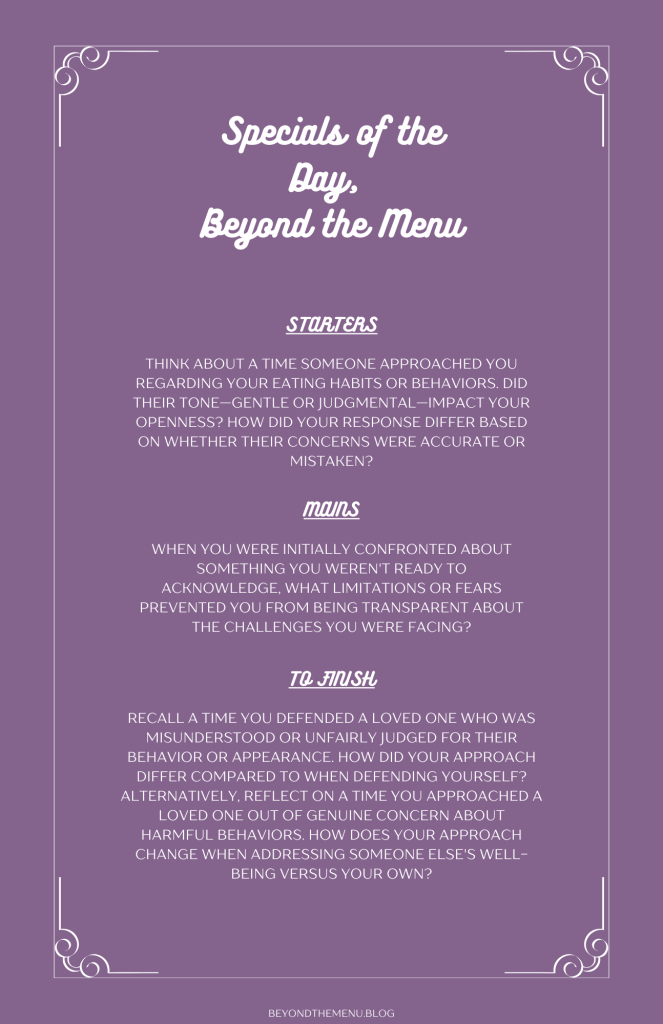
Embracing change and collaboration with others is crucial for genuinely confronting and overcoming the internal challenges we face. To support this reflection, the Specials of the Day, Beyond the Menu encourage you to explore how defense mechanisms impact and limit your openness toward personal growth, especially regarding sensitive topics such as disordered eating behaviors. Ultimately, recognizing when we are falsely defending—deflecting rather than truly protecting ourselves—can be a pivotal moment for self-awareness and healing.
References:
Aouad, P., Hay, P., Foroughi, N., Cosh, S. M., & Mannan, H. (2021). Associations Between Defence-Style, Eating Disorder Symptoms, and Quality of Life in Community Sample of Women: A Longitudinal Exploratory Study. Frontiers in Psychology, 12. https://doi.org/10.3389/fpsyg.2021.671652
MacNeil, L., Esposito-Smythers, C., Mehlenbeck, R., & Weismoore, J. (2012). The effects of avoidance coping and coping self-efficacy on eating disorder attitudes and behaviors: A stress-diathesis model. Eating Behaviors, 13(4), 293–296. https://doi.org/10.1016/j.eatbeh.2012.06.005
 Beyond The Menu
Leave a comment